PALLAY PUNCHU, EVERYTHING YOU NEED TO KNOW BEFORE VISITING
Pallay Punchu Rainbow Mountain is one of the most surprising and least crowded natural destinations in Cusco. Famous for its sharp formations and intense colors that resemble an Andean poncho, it offers a more peaceful and authentic experience than other colorful mountains. Visiting Pallay Punchu is ideal for travelers who seek unique landscapes, contact with nature, and a hike surrounded by silence, altitude, and Andean beauty.
History
Since ancient times, the mountain now known as Pallay Punchu has been a sacred place for the Andean communities that lived in the southern Cusco region. Its name, which in Quechua means “woven poncho,” reflects how ancient inhabitants saw its natural colors as a message from the earth, a living manifestation of Pachamama.
In the Andean worldview, mountains were considered Apus, protective spirits that watched over communities, crops, and the balance of life. Pallay Punchu, with its intense bands of color, was interpreted as a ceremonial mantle, a symbol of protection and abundance. Each shade represented the relationship between human beings, nature, and the gods of the highlands.
During the Inca period, this mountain formed part of the sacred landscape that connected routes, communities, and ritual spaces. It was not an urban or military center, but rather a spiritual and cultural reference point, used for ceremonies, offerings, and moments of contemplation. People came to this place to give thanks for their harvests, seek balance, and show respect to the earth.
¿What do the colors of Pallay Punchu mean?
The colors that cover Pallay Punchu Mountain are not only a striking natural phenomenon, but also reflect symbols deeply rooted in the Andean worldview. Each tone can be interpreted as a representation of the relationship between human beings, the earth, and the universe.
The reddish and ochre tones evoke the strength of Pachamama, the fertile earth that gives life and nourishment. These colors are associated with origin, the blood of the earth, and the vital energy that sustains Andean communities.
Green tones symbolize life, growth, and hope, connected to agriculture, natural cycles, and the constant renewal of nature. They represent the balance that Andean peoples sought to maintain with their environment.
Yellow and golden colors are related to the sun, abundance, and prosperity—essential elements for life in the Andes. These colors recall the importance of Inti as the source of warmth, light, and natural order.
The colors of Pallay Punchu form a visual language of nature, a message that expresses balance, respect, and harmony.
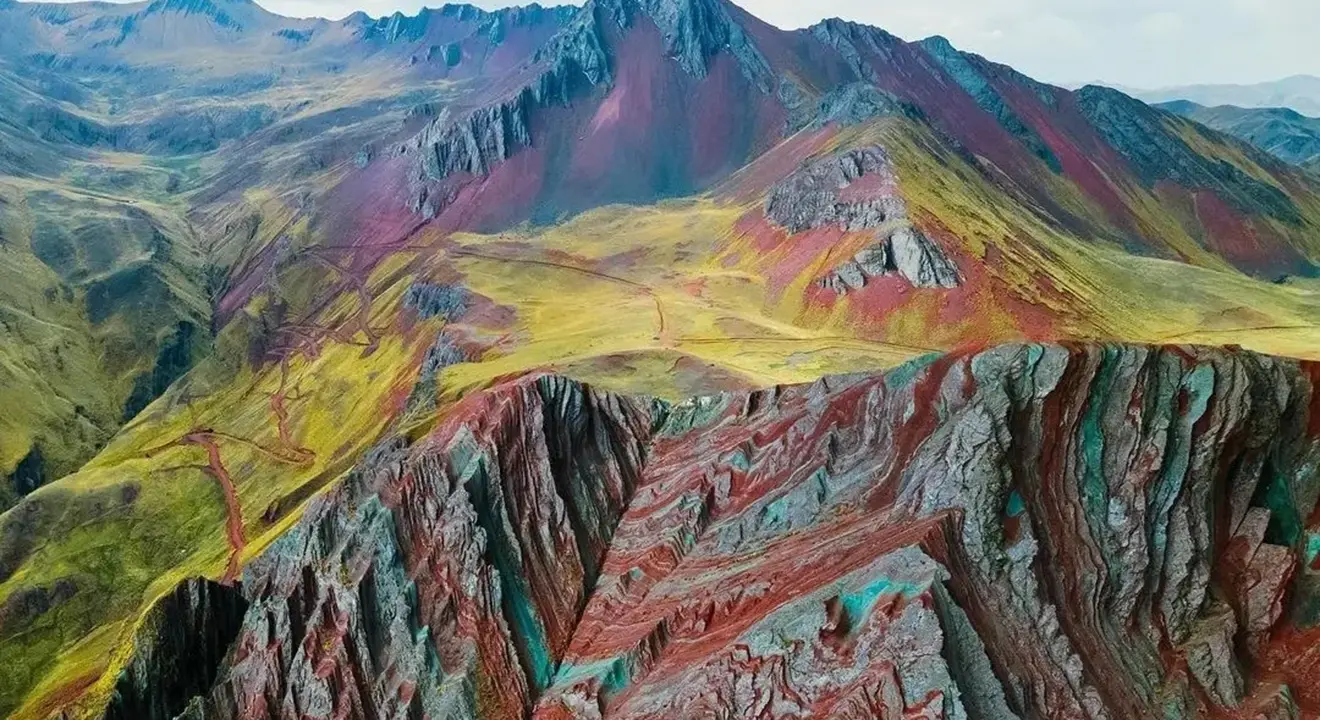
Location and altitude of Pallay Punchu
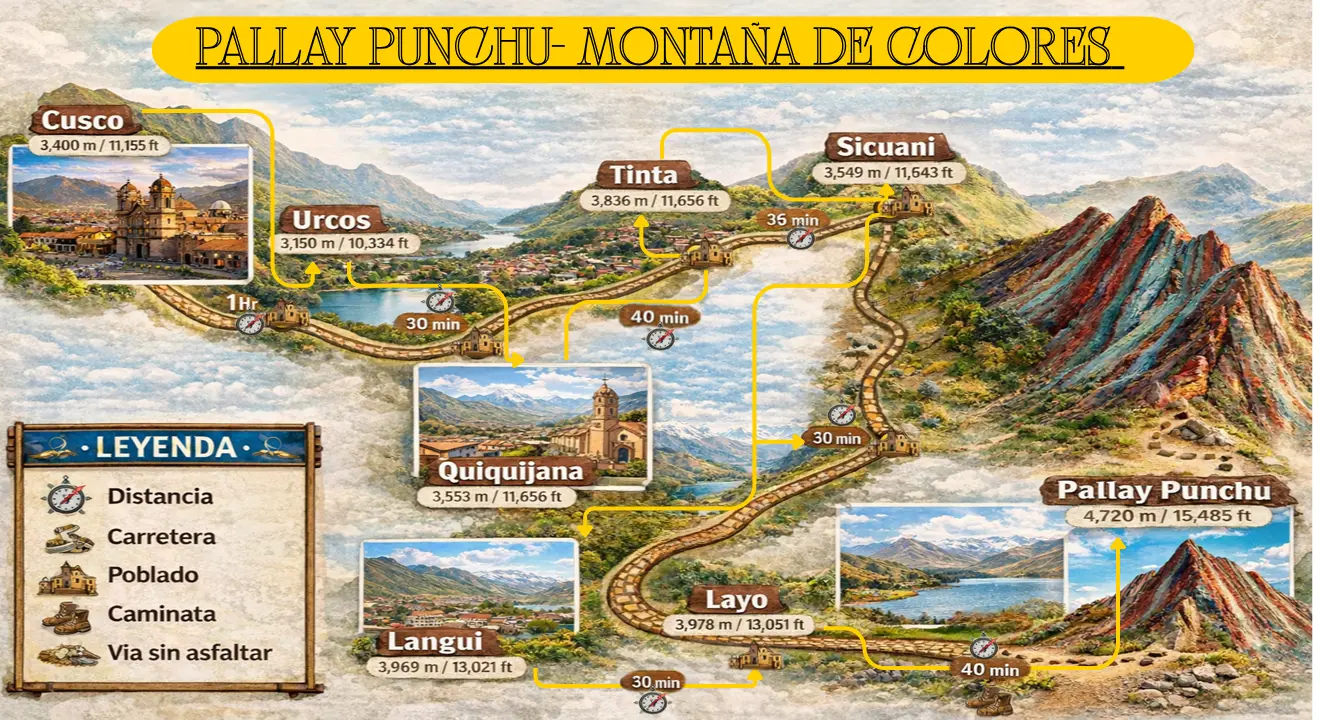
Pallay Punchu Mountain is located in the district of Layo, within the province of Canas, south of the Cusco region. It rises to an approximate altitude of 4,700 meters above sea level (15,419 feet), placing it in the high Andean mountains.
This impressive landscape is located very close to Lake Langui, surrounded by mountains, wide fields, and a natural environment that stands out for its tranquility and beauty. Thanks to its location, Pallay Punchu offers visitors unique views of the Andes and an authentic experience in direct contact with Cusco’s natural surroundings.
How to visit Pallay Punchu from Cusco
To reach Pallay Punchu, you must first travel from the city of Cusco to the district of Layo, in the province of Canas. The road trip takes approximately 4 to 5 hours, passing through high Andean landscapes, rural communities, and spectacular views of the southern highlands of Cusco.
From Cusco, you can take transportation to Sicuani and then continue to Layo. Once in the area, the final access is done by a short hike of moderate difficulty, which allows you to appreciate the mountain in all its splendor. The trail is accessible, but due to the altitude, it is recommended to walk at a slow pace and bring warm clothing.
Many travelers choose to visit with local agencies, which makes transportation, guidance, and safety during the journey easier. However, it is also possible to go on your own if you plan in advance.
Visiting Pallay Punchu is not only a trip to a multicolored mountain, but an experience that connects the visitor with the most authentic landscapes of the Peruvian Andes.
¿What is the best season to visit Pallay Punchu?
The best season to visit Pallay Punchu is during the dry season, which runs from April to November, because during these months the weather is more stable, there is less rain, the roads are in better condition, and the colors of the mountain can be appreciated more intensely.
Recommended season (April – November):
✅ Mostly clear days
✅ Better visibility of the landscape
✅ Safer and more pleasant hikes
Rainy season (December – March):
📌 Frequent rainfall
📌 Slippery paths
📌 Reduced visibility due to fog
Recommendation : The ideal months are May, June, and July, when the weather is cold but dry and the views are spectacular.
Difficulty level and hike
The hike to Pallay Punchu is of moderate difficulty, mainly due to the altitude, which exceeds 4,700 m.a.s.l. The route is not technical and does not require previous mountaineering experience, but it does require good physical condition and proper acclimatization in Cusco or nearby areas.
The trail includes uphill sections, uneven terrain, and exposure to wind, which can make the effort feel greater, especially for those not used to high altitude. Therefore, this hike is ideal for adventurous travelers, nature lovers, and people who enjoy trekking, even if it is their first experience, as long as they walk at a slow pace.
It is not recommended for small children or for people with respiratory or heart problems without prior medical consultation. With basic preparation, constant hydration, and breaks along the way, the experience is completely achievable and very rewarding.
¿What wonders will you discover at the Pallay Punchu Rainbow Mountain?
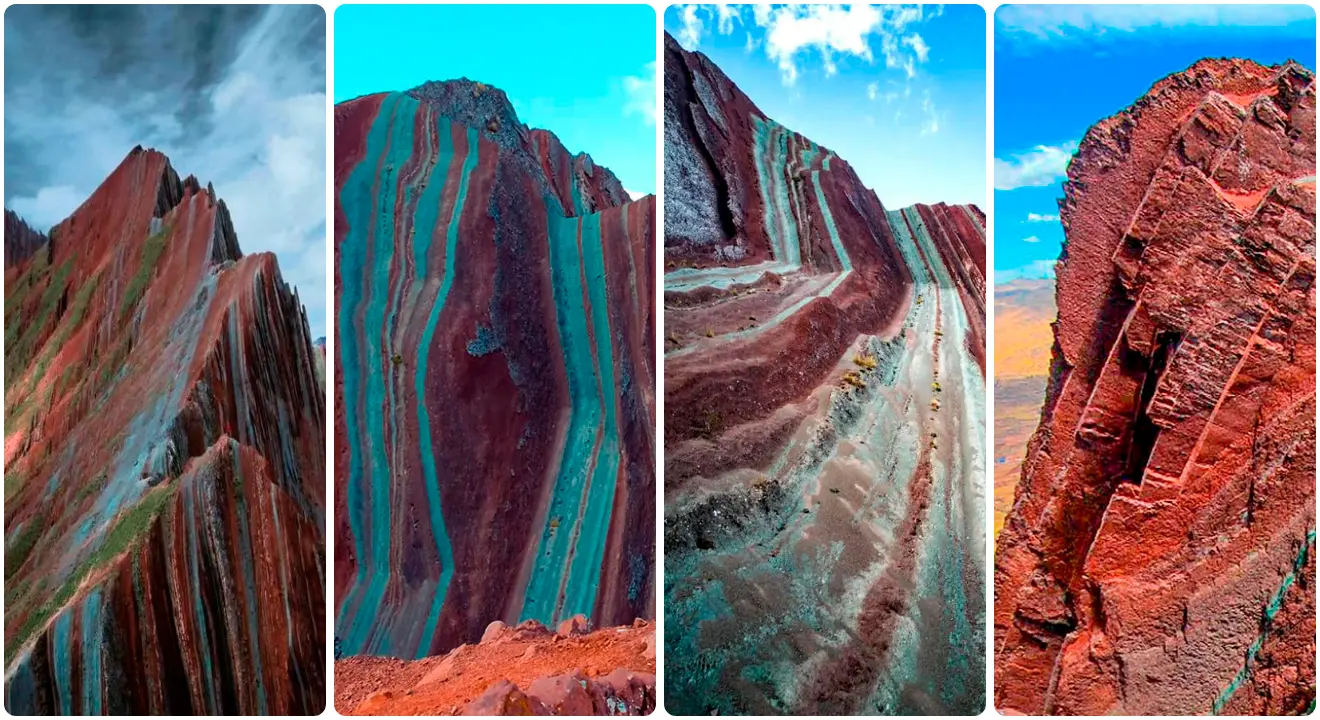
When visiting Pallay Punchu, you will encounter a unique and uncommon landscape in the Andes. The first thing that stands out are its slopes covered with natural multicolored stripes, where red, ochre, yellow, green, and brown tones predominate, formed by minerals and sediments exposed over time.
From the natural viewpoints, you can observe sharp shapes and rugged reliefs that resemble folds of fabric, giving the sensation that the mountain is “woven.” Depending on the time of day and the sunlight, the colors change in intensity, creating an impressive visual spectacle.
In addition, the surroundings offer panoramic views of the southern Andes of Cusco, with mountains, rolling hills, and, on clear days, the nearby Langui Lagoon, which complements the landscape with blue tones and natural reflections.
It is also possible to observe high-Andean wildlife such as birds, llamas, and alpacas, as well as to feel the tranquility and energy of a little-visited place, ideal for photography, contemplation, and connection with nature.
What to bring to Pallay Punchu
- Identification document or passport: Especially if you are a foreigner and it may be requested at checkpoints or by the agency.
- Layered clothing: Light shirt + fleece or jacket + windbreaker. The weather changes quickly.
- Waterproof jacket: Essential in case of rain, hail, or strong wind.
- Trekking pants: Comfortable, resistant, and quick-drying.
- Hiking boots: Waterproof and with good soles for uneven terrain.
- Hat and gloves: Especially in the morning and at the summit, where it is cold.
- Buff or scarf: Useful against wind and cold.
Essential accessories
- Water bottle or thermos: Stay hydrated during the hike.
- Energy snacks: Nuts, chocolate, energy bars, or fruit.
- Sunscreen (high SPF): The sun is stronger at high altitude.
- Sunglasses: Protect from sun, wind, and glare.
- Small backpack: To carry only what is necessary.
- Toilet paper: Important, since there are not always facilities.
- Trekking poles: Help on ascents and descents, reducing effort.
- Camera or phone with battery: To capture the landscapes.
- Cash: There are no ATMs in the area.
- Personal medication: Especially for altitude sickness.
What not to bring
- Large or heavy backpacks
- Urban clothing or inappropriate footwear
- Alcoholic beverages
- Unnecessary valuables
- Drones (not allowed in many areas)
🤔 Fun facts about Pallay Punchu
- It is known as the Poncho Mountain because of its natural colored formations that resemble traditional Andean textiles.
- Unlike other rainbow mountains, its stripes are more defined and angular, giving it a unique and less common appearance in the Andes.
- It is a little-visited destination, which allows for a quieter and more authentic experience, away from mass tourism.
- Its colors intensify depending on the time of day, especially in the early morning hours.
- For local communities, the mountain is considered an apu, a sacred mountain linked to protection and the balance of nature.
We are accredited by