RAINBOW MOUNTAIN, VINICUNCA: EVERYTHING YOU NEED TO KNOW BEFORE YOU GO.
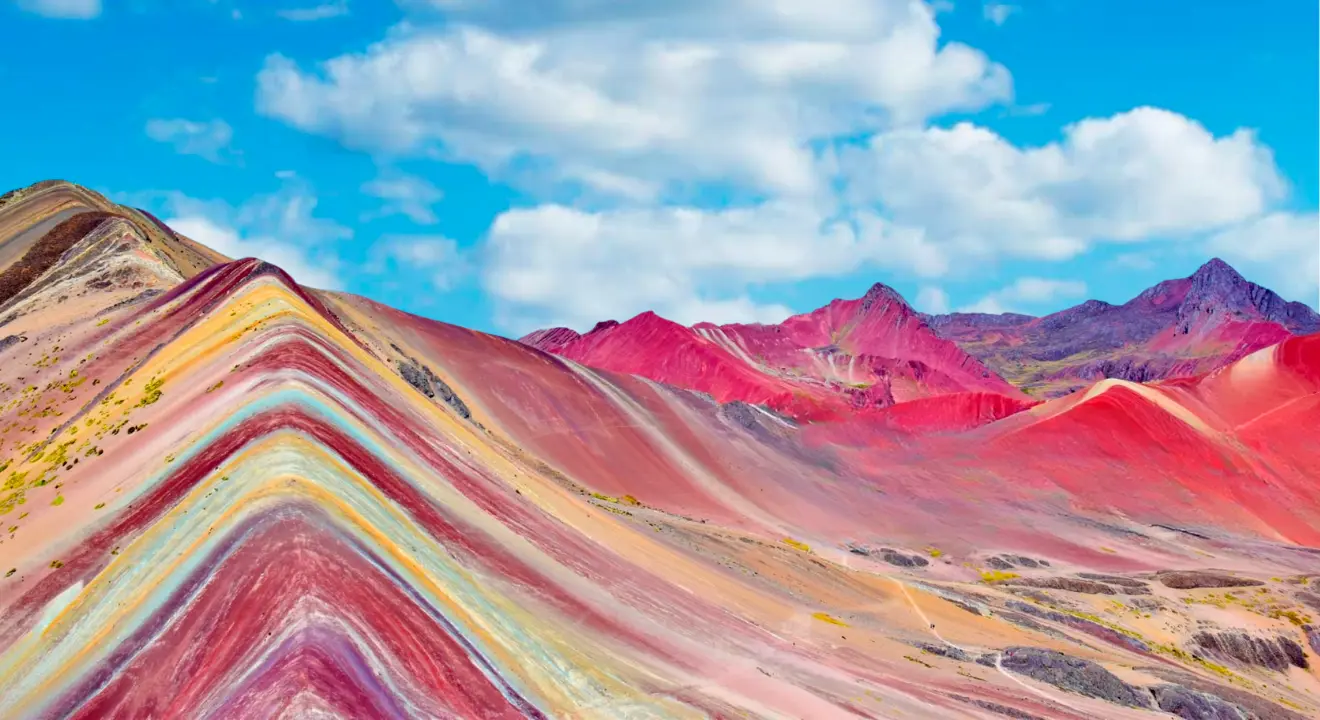
Be amazed by the magnificent Seven Colors Mountain, Vinicunca, or Rainbow Mountain, one of the most spectacular landscapes in Peru with intense natural stripes. The mountain’s colors consist of shades of red, green, brown, yellow, and purple, making it an incredible place.
Located in the Andes region of Cusco, this tourist destination offers the perfect opportunity to experience nature, adventure, and stunning views while exploring Vinicunca. It provides an amazing and memorable experience at high altitude for all those looking to enjoy the best landscapes and create unforgettable moments.
The natural history of Vinicunca: how the Rainbow Mountain was born
For centuries, the Seven Colors Mountain remained hidden under a thick layer of snow and ice in the Andes of Cusco. For local communities, this place was always part of their sacred territory, linked to the Apus or protective mountain spirits, within the Andean worldview. It was not a tourist destination, but a respected and seldom-visited space due to its extreme altitude and climatic conditions.
With the retreat of glaciers caused by climate change, around the 2010s the mineral stripes that give it worldwide fame began to appear. It was then that Vinicunca started attracting travelers and explorers, quickly becoming one of Peru’s most iconic landscapes.
Its colors are due to the accumulation of minerals over millions of years, resulting from complex geological processes. This natural phenomenon, combined with Andean cultural tradition, transformed Vinicunca into a symbol of the meeting between Earth’s history and the ancestral heritage of the Andes.
Vinicunca: Seven Colors Mountain, Location, and Altitude
The Seven Colors Mountain, known as Vinicunca, is located in the Cusipata district, Quispicanchi province, in the Cusco region of Peru. It lies in the Vilcanota mountain range, very close to the Ausangate snow-capped peak, one of the most important sacred mountains in the Andes.
Its altitude is approximately 5,200 meters / 17,060 feet above sea level, making it a high-altitude destination. Due to this elevation, the hike requires good acclimatization and allows visitors to observe extreme Andean landscapes, with mountains, glaciers, and vast natural valleys.
Origin of the colors of the Seven Colors Mountain
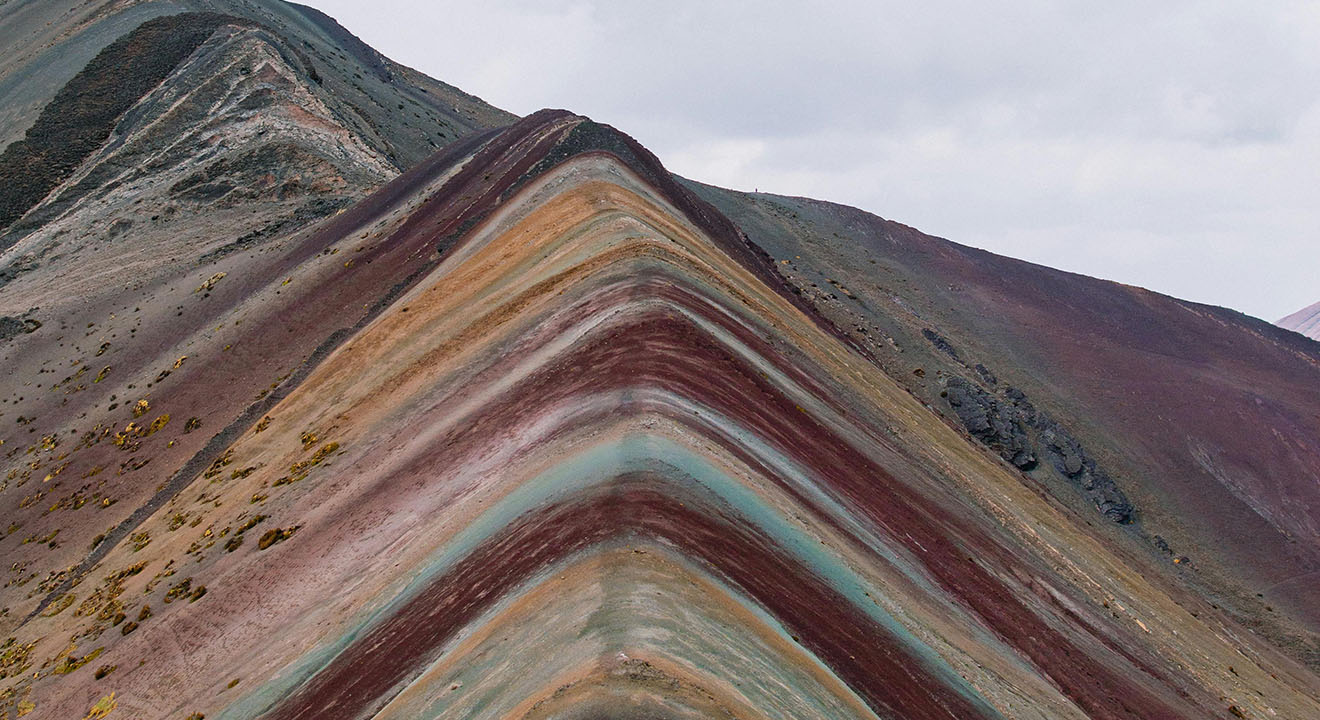
The Seven Colors Mountain, known as Vinicunca, is the result of a long geological process involving sedimentation, tectonic activity, and erosion. Its hues are neither superficial nor artificial; they correspond to mineral layers formed at different times in geological history and are now exposed after the uplift of the Andes Mountains.
Geological Formation
Between the end of the Cretaceous period and the first million years of the Paleogene, this region was marked by the accumulation of sediments in ancient marine, fluvial, and volcanic environments. Over time, these materials compacted into mineral layers. Later, tectonic movements uplifted the terrain, and erosion processes, especially glacial melting, exposed the multicolored layers that characterize Vinicunca.
Mineral composition and origin of its hues
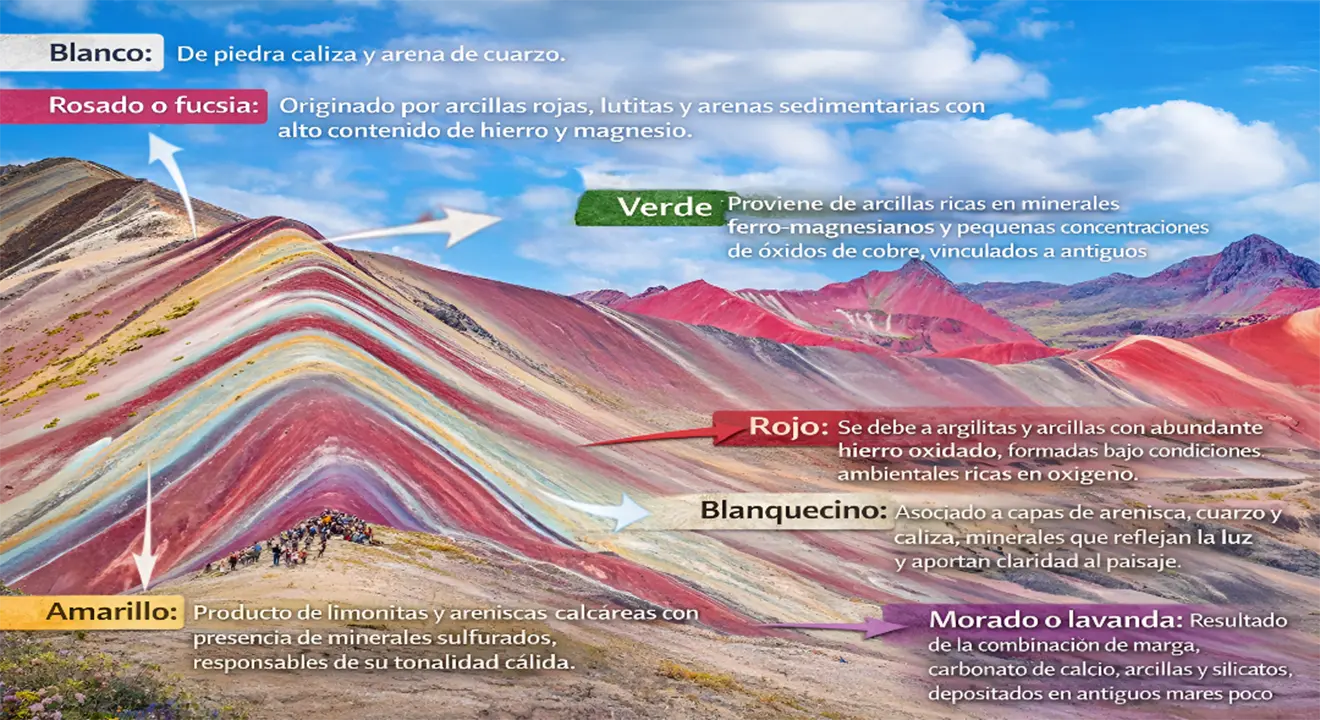
Each color stripe on the mountain is associated with a specific type of mineral:
- White: From limestone and quartz sand.
- Pink or fuchsia: Originates from red clays, shales, and sedimentary sands with high iron and magnesium content.
- Green: Comes from clays rich in ferro-magnesian minerals and small concentrations of copper oxides, linked to ancient volcanic episodes.
- Red: Due to argillites and clays with abundant oxidized iron, formed under oxygen-rich environmental conditions.
- Whitish: Associated with layers of sandstone, quartz, and limestone, minerals that reflect light and add brightness to the landscape.
- Yellow: Product of limonite and calcareous sandstones with the presence of sulfur minerals, responsible for its warm tone.
- Purple or lavender: Result of a combination of marl, calcium carbonate, clays, and silicates, deposited in ancient shallow seas.
When to Visit the Mountain of 7 Colors
Best season: dry season (May to September)
- There is less rain, making access and hiking easier.
- Trails are firmer and safer.
- The sky is usually clear, allowing the mountain’s colors to be seen clearly.
- Better visibility for photos and landscapes.
- The most popular months are June, July, and August, though they are also the most crowded with tourists.
Intermediate season: April and October
- Few rains occur.
- Fewer visitors than in high season.
- Colors are still visible, and the climate is relatively stable.
- Not recommended: rainy season (November to March)
- Frequent rains, especially between January and February.
- Trails can become slippery and dangerous.
- Fog and clouds may hide the mountain’s colors.
- On some days, access may be closed for safety.
Traveler tip: For the best visual experience and maximum safety, visit Vinicunca between May and September. If you prefer fewer crowds and still good weather, April and October are excellent options.
Flora, Fauna, and Landscapes Around Vinicunca
The Mountain of 7 Colors, besides being famous for its stunning mineral hues, stands out for the natural environment surrounding it. Located in the Vilcanota mountain range, it offers a unique high-Andean landscape combining flora, fauna, water bodies, and spectacular views. Key highlights include Andean peaks and glaciers like Ausangate, open valleys, highland pampas, reflective lagoons, and trails flanked by rocky formations and hills. The landscape changes with the season, showing green tones during the rainy season and drier, more intense colors in the dry season.
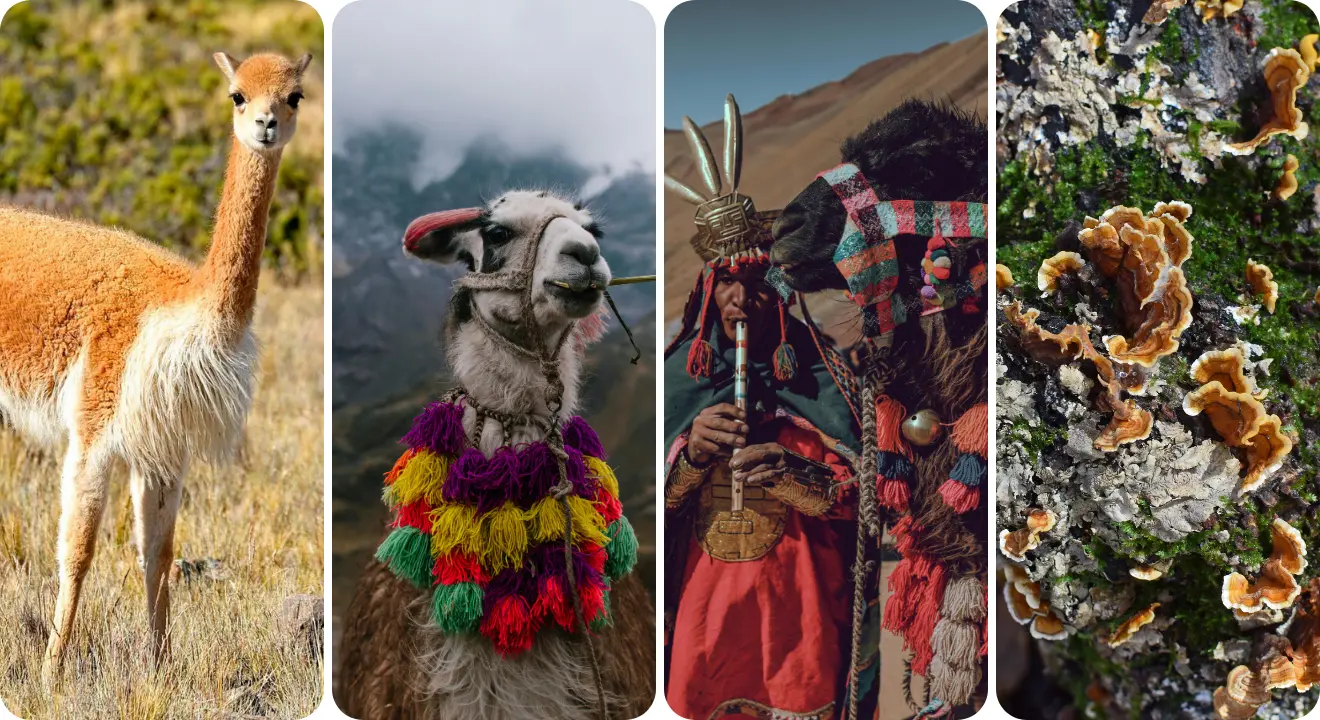
Vegetation is limited due to the high altitude but very resilient, with ichu grass covering much of the terrain, mosses and lichens on rocks, small shrubs adapted to cold and wind, and medicinal plants used by local communities. Regarding fauna, it is possible to see llamas and alpacas raised by Andean populations, wild vicuñas, vizcachas living among rocks, and high-Andean birds such as caracaras, huallatas, and even the majestic Andean condor in flight.
Cultural Experience
Along the route, it is common to encounter:
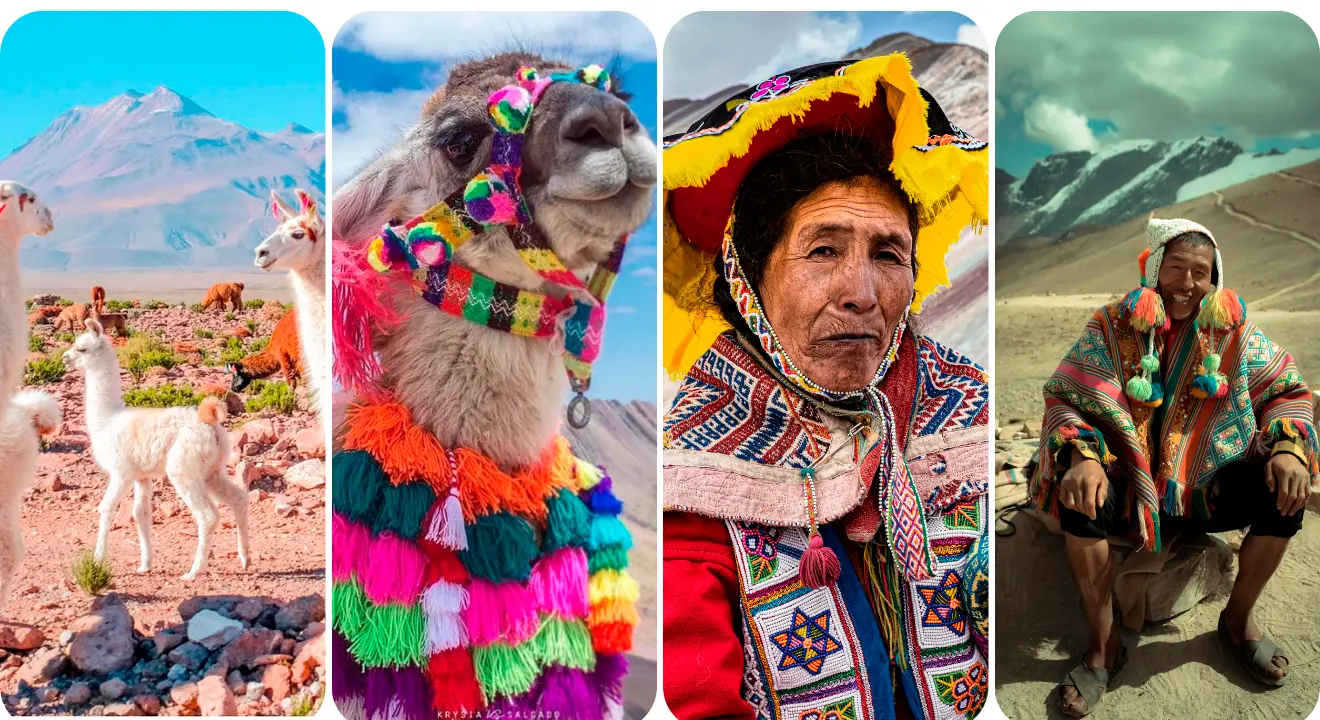
- Local communities dedicated to herding.
- Traditional Andean clothing.
- Small craft and typical food stalls.
- Vinicunca offers a complete experience where the landscape, wildlife, and Andean culture come together in one of the most impressive natural settings in southern Peru.
Vinicunca: Recommendations for climbing the Rainbow Mountain
| Category | Details |
|---|---|
| Who can go |
|
| Who should take caution |
|
| Tips for a safe visit |
|
| Altitude and effort |
|
The 4 Routes to Reach the Mountain of 7 Colors
The Mountain of 7 Colors, also known as Vinicunca or Rainbow Mountain, is one of the most impressive destinations in Peru. Its color stripes and natural surroundings attract visitors from all over the world. If you plan your visit, it is important to know the available routes to choose the one that best suits your style and level of preparation.
1. Cusipata Route: The most popular and accessible
Distance and walking time:
- From Phulawasipata to Vinicunca: 7 km round trip
- Approximate time for ascent only: 1 hour 30 minutes (one way)
Advantages:
- Very accessible with available tourist services.
- Allows visiting the Red Valley, a natural landscape full of color and beauty.
Disadvantages:
- It is the most crowded route, especially in high season, so it is common to find crowds.
2. Checacupe – Pitumarca Route: For those seeking tranquility
Distance and walking time:
- From Kayrawiri to Vinicunca: 8 km round trip
- Approximate time for ascent only: 2 hours 30 minutes (one way)
Advantages:
- Fewer tourists on the way, ideal for those who want a quieter journey.
- Impressive Andean landscapes, with direct contact with nature and local culture.
Disadvantages:
- The journey by public transport from Cusco is longer than from other routes.
3. Ausangate Route: The multi-day adventure
Distance and walking time:
- Total route: 15 km
- Duration: 4 days and 3 nights, designed for intense trekking.
Advantages:
- Perfect for those seeking an authentic and challenging experience.
- Allows exploring nature in its pure state, including views of Nevado Ausangate and the Mountain of 7 Colors.
- Less traveled, ideal to enjoy tranquility and unique landscapes.
Disadvantages:
- Physically demanding due to duration and altitude.
- Requires prior acclimatization in Cusco to avoid altitude sickness.
4. Cusco Route: Cusipata – Mountain of 7 Colors (with tour, most recommended)
If what you are looking for is comfort, safety, and a worry-free experience, hiring an organized tour to the Mountain of Seven Colors (Vinicunca) is the best option to visit it. With a tour, everything will be prepared for you, from transport to expert guides, so you only have to focus on enjoying this natural wonder to the fullest.
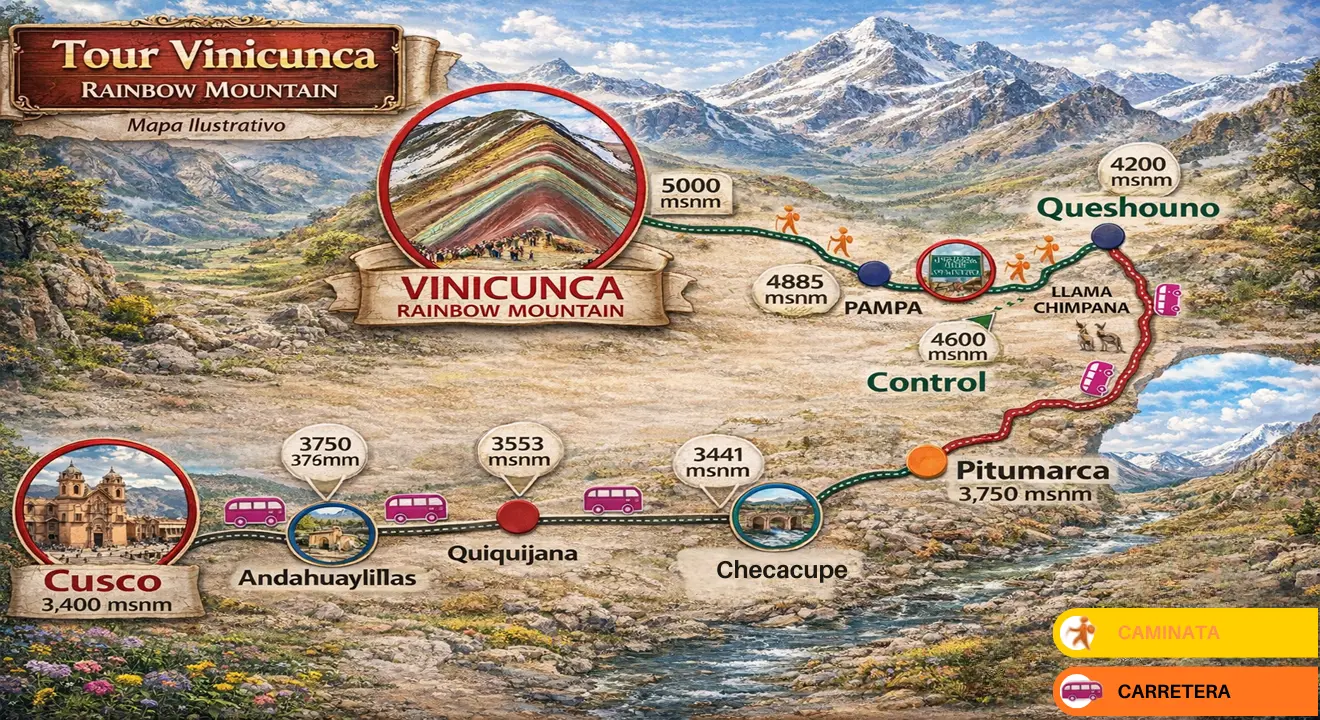
1. From Cusco to Cusipata
- The first leg is to travel from Cusco to Cusipata, a town near the starting point of the hike.
- Distance: Approximately 85 km.
- Travel time by vehicle: Between 2 and 3 hours on paved and partially dirt roads.
- Transport options: Pickup at your hotel in Cusco, round-trip transfer to Vinicunca in private and comfortable vehicles.
- Approximate route: Cusco – San Jerónimo – San Sebastián – Piquillacta – Oropesa – Cusipata.
- Recommended schedule: Departure between 3:30 a.m. and 5:00 a.m. to take advantage of daylight and avoid setbacks.
2. From Cusipata to the starting point of the hike
Once in Cusipata, the next step is to travel to Phulawasipata, the point where the hike begins.
- Distance: 15–20 minutes by car from Cusipata.
- Starting altitude: Approximately 4,300 m above sea level, which reduces the effort due to altitude.
- What to do there: This is where the 7 km round-trip trek to Vinicunca begins.
3. Hike to the Mountain of 7 Colors
The trek from Phulawasipata to the summit is the most exciting part of the adventure:
- Distance: 7 km round trip.
- Estimated duration: 1 hour 30 minutes ascent (depending on pace and acclimatization).
- Difficulty level: Moderate, mainly due to altitude and slopes.
- Traveler tip: Bring layered clothing, water, snacks, and maintain a steady pace to enjoy the hike without problems.
Comfort and Benefits of an Organized Tour
- Professional guide: Our expert guides in local culture and geography accompany you throughout the tour, sharing fascinating information about the mountain.
- Lunch included: Box lunch to recharge energy after the hike.
- Safety and convenience: Traveling with a tour ensures support in any eventuality, saves time, and eliminates logistical worries.
- Cultural connection: Guides tell stories about Andean culture and Vinicunca’s unique geology.
- Options for all travelers: From shorter routes to longer experiences, there is a tour adapted to every need, experience level, and budget.
What to bring
- Layered clothing: Fleece, windbreaker, and waterproof jacket to adapt to temperature changes.
- Comfortable and sturdy trekking boots: Prevent slipping and protect your feet on uneven terrain.
- Sun protection: Hat, sunglasses, and high-factor sunscreen.
- Water and energy snacks: Stay hydrated and energized during the hike.
- Trekking poles (optional): Help you balance on ascents and descents.
- Camera or smartphone: To capture the landscapes, making sure to protect them from cold and moisture.
- Small backpack: Only the essentials, light to avoid extra weight.
- Documents and money: ID or passport, cash (for entrance fees, taxis, or snacks).
- Basic medication: Painkillers, gastric protectors, altitude sickness tablets, or any personal medication.
What not to bring
- Large suitcases or unnecessary luggage: You will not be able to carry them during the hike.
- Inadequate shoes: Avoid flat-soled sneakers or sandals.
- Unnecessary valuables: Risk of loss or damage during the hike.
- Perishable foods without proper packaging: Avoid foods that can spoil easily.
- Alcohol or substances that affect your acclimatization: Can increase altitude sickness.
Curious fact:
- Permits and logistics: Everything is managed, from entrance tickets to transportation and schedule coordination.
- Vinicunca changes color according to the light and time of day.
- It doesn’t always look the same; colors can appear more intense at sunrise or sunset, when sunlight hits the mineral stripes obliquely.
- Even the dry or rainy season can modify the tone perceived by visitors, making each visit unique and different.
We are accredited by